Pickle
Programs At The Conclave Learning Conference
On July 15, 2011,
Chancey Blackburn, EVP Sales and Marketing for Pickle Programs, participated
in the panel discussion, “Make Technology Work Harder For Your Bottom Line”
at the 38th Annual Conclave Learning conference in Minneapolis.
Chancey joined other management executives to discuss how broadcasters
can utilize new technologies to run their businesses more effectively and
efficiently. Chancey explained the time savings obtained when Pickle
Programs’ AirCheck™ software is utilized to automatically distribute spot
times to advertisers. The software also makes it possible to post an ad
schedule within the flight to prevent credits and write offs from
under-delivery. Other panelists included Scott Musgrave, EVP of Business Development for MediaDash and David Einstein from Efficio Solutions. Warren Kurtzman of Coleman Insights moderated the panel.
Tuesday, September 15, 2009
Do more with less isn’t just radio’s operating
standard. A new survey shows two-thirds of marketers are being told by
their companies to drive more sales with the same or lower budget — and
three-quarters say their marketing budget has shrunk this year. Facing
that challenge, accountability has taken on a much greater significance.
The survey was conducted by Association of
National Advertisers (ANA) and Marketing Management Analytics (MMA).
ANA president Bob Liodice says, “With marketers,
CFO’s and CEOs paying more attention to each dollar spent, marketing
accountability processes have become strategic imperatives.” That’s where
radio posting becomes a factor. Radio Advertising Bureau CEO Jeff Haley
says such accountability is “an important component” of radio’s growth.
“As radio aims to grow its share of ad dollars, proof of performance and
streamlined commercial workflow are increasingly important at the station
level,” he says. Radio
One has begun rolling out its “Accountability One”, posting software, (by
Pickle Programs), to all markets and its timing couldn’t be better. MMA SVP Douglas
Brooks says, “With the economy still struggling to find its way out of the
doldrums, marketing accountability has moved from the category of nice to
have to must-have.” Virtually all (92%) the firms that took part in the
ANA-MMA survey say they’re taking steps to improve marketing effectiveness
without spending more. Seven in ten say they’re doing that by shifting
from traditional to digital media with more than half (53%) shifting from
brand-building to promotional marketing. But there’s good news for
radio too. Nearly four-in-ten (38%) are shifting to lower-cost media.
“Posting” of radio ads’
performance PPM ratings is now possible within two or three weeks.
Pickle Programs says its software “for the first time in radio
history” will automate the process of comparing how a client’s ad schedule
ran versus the Arbitron People Meter ratings. Posting is something many radio
operators have resisted, long before issues of sample size and credibility
surfaced with the PPM. (Posting’s been standard operating procedure in TV for
years.) But Pickle finds an early adopter in Radio One, whose radio division
chief Barry Mayo says they’ll use the software under the name “Accountability
One.” (Radio One likes the continuity of “One” in its various businesses.)
The hope is that more accountability leads to more confident
spending by advertisers and agencies. “More spending” was Arbitron’s original
promise for the PPM, years ago. In this economy, it’s hard to separate out
its effect, but I can definitely find some skeptics at the station level.
Pickle’s Chief Technology Officer Rick Galloway says “Radio posting becomes
inevitable” with electronic measurement. He also cites “the growing anxiety
among advertisers that they may not be getting what they pay for.”
As new technology allows PPM posting, Radio One
embraces it across all markets.
A yearlong posting pilot program in Houston has been deemed a success as Radio
One signs a group deal to take Pickle Program’s software nationwide.
Integrating with traffic and billing systems, it allows users to track how an
ad campaign is delivering audience using PPM ratings and parameters set when
the contract was signed. Pickle SVP Chancey Blackburn says, “By monitoring,
stations can put in bonus weight before the buyer calls and isn’t happy.”
Radio One positions it as “Accountability One” to
advertisers. While difficult to tie to revenues, regional VP Doug Abernathy
notes Houston
billings are “significantly out-pacing” the market’s 22% decline this year.
“When we go to advertisers there such an ‘oh wow’ factor,” he says. Many
broadcasters worry post-buy analysis will become a new way for agencies to
beat stations down on price or lead to frequent demands for bonus spots. But
due to the stability of PPM data, over the last 12 months Radio One says
there was a single occasion when a Houston
campaign under-performed. “The beauty is we called them,” says Abernathy.
“Guess who’s still spending with us?” Such posting relies on a consensus that
PPM ratings are valid — something not everyone is willing to do. Abernathy
says, “We can debate it all day long, but if we’re going to compete in this
digital world we can’t ask advertisers to wait 150 days — it’s just archaic.”
Blackburn, a former radio salesperson and Madison, WI
station owner, tells Inside Radio one reason the medium hasn’t been forced to
post before was by the time agencies received diary ratings the campaign is
typically long over. “It strengthens radio’s position overall,” she says,
“and it demonstrates that it actually deserves a greater share of a
multimedia budget.”
Agencies embrace Pickle, but the RAB’s
guidelines remain more conservative.
Pickle Program’s PPM-based posting software is drawing praise from
ad agencies, where the call for improved radio posting grows louder. Horizon
Media SVP and director of local radio Lauren Russo says, “Until now, ad
agencies have had to wait several weeks, even months, to learn if the radio
schedule they purchased actually delivered the audience their client
expected.” With a station able to track delivery more closely — even daily in
some cases — she says it proactively avoids advertiser run-ins. “Radio
becomes a much more viable and accountable medium when you can avoid
under-delivery problems,” says Russo. With double-digit industry declines,
owners hope it leads to more revenues. RAB president/CEO Jeff Haley says,
“Accountability is an important component of radio’s growth.” Posting
guidelines approved by the RAB Board last May are more conservative than what
Pickle and Radio One will employ. The RAB suggests stations use a three-month
rating average rather than a single month, and believes a campaign’s
performance should be assessed based on how all stations on the buy averaged,
not on a station-by-station basis. But the RAB guidelines say whatever is
used depends on what the agency and station agree to. Haley says, “The
industry is committed to working with the buying community to provide the
proof of performance that is expected in today’s environment.”
— • —
"Oh, and the Clients wants you to
call in their times each day" June 1, 2006
TDGA Product
Preview: Giving Your Advertisers the Time(s) of Day!
The Clients want their times. How many times has a Traffic
person heard that phrase? In some cases, it’s a fairly easy task because the
schedules are rather uncreative and follow a pre-set pattern. But for the
more sophisticated schedule, it’s just one more time-intensive project to
dump on an already over-worked staff. We found one solution that takes the
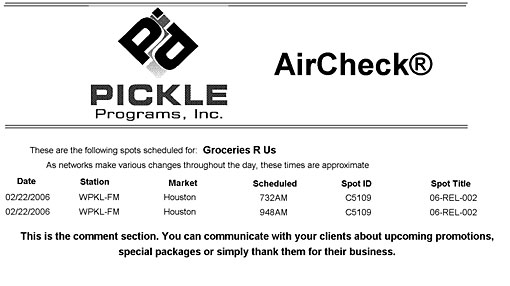
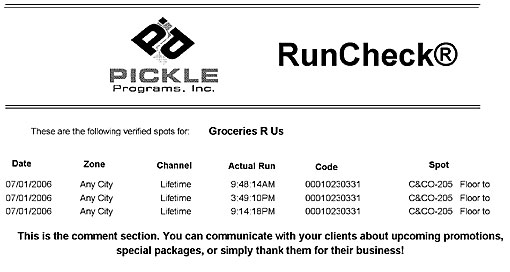
station personnel out of that workload. A software program called AirCheck
and a companion add-on: RunCheck.
Stations have all sorts of solutions. One is to have a junior member of the
staff sit by the phone each afternoon after the next day’s log has been run
and liter ally call each client that wants the service. An Office Manager or
Business Manager can tell you—that’s an “almost” non-productive task and very
prone to human error.
Another solution is to give the Salesperson the printout of spot times, usu ally via a printout delivered to his desk and saying:
“Good luck, big boy, and happy phone calling. If the salesperson was a
producer, this is another real cost to the bottom line.
In frustration, most Stations simply say—we don’t provide times in advance of
Broadcast. The hardest thing in selling is to tell an advertiser or potential
advertiser: No, we don’t do that or can’t do that. More than one TDGA
Member has come to us asking—how do you handle that. Actu
ally, we knew of one New Jersey Station that charged 50-cents a day to call
in times to a client. Of the hundreds of accounts (it was a busy station),
less than 1% ever agreed to pay for that service—but the requests didn’t
stop. It was even more difficult when competitors did it as a part of their
service to the client. So we embarked on tracking down the solution.
Pickle Programs software provides an automatic means of collecting advertiser'’
spot times and automatic ally delivering it to selected clients by fax or by
email. It’s a software solution that works in conjunction with most existing
traffic software systems. They offer several programs- AirCheck, RunCheck and RunRate. (RunRate is an internal program for groups or multi-market
operators that need to check operating discrepancies within each market and
spot locations where the error rate is costing you money.)
The material being sent can be customized replacing the sample logos shown
with your station or corporate branding and the text offers a nice promo tool
to alert advertisers to upcoming advertising opportunities. Space limitations
required us to condense the screen shots, but they can be seen in far more
detail on the company’s website.
AirCheck provides the times and copy identifier in advance of the advertisers
broadcast, while RunCheck provides a quick report
following broadcast. This might be just what you’re looking for and certainly
worth discussing within your own Management and Sales Department circle.
Pickle can be set to send either scheduled or verified spot times (or
both). The times are taken from completed logs or verification
reports. Data Entry in Pickle is quick and easy and only needs to
happen once per client in order for them to receive times for all orders.
Advertisers can choose to receive their times by fax, email or both – up to
two fax numbers and up to 4 email addresses. The information is client
specific and can include or exclude spot rates and bonus or fill times.
Pickle can even send schedule data in Spanish.
Pickle can reside on your station(s)’ network so it can be easily accessed by
multiple users. Addition ally, a log is kept of all emails and faxes
sent each day for quick reference and confirmation.
In short, these programs, one or the other (or both) means no more calling,
faxing or emailing. Pickle does the work reliably and accurately every
day – even when you’re not there!
Your sales team will also appreciate how easy it is to set up their clients
to receive their times. And they can include a custom message on the
fax or email, telling the client about a new sales package, a promotion or
just to thank them for their business.
If you want to check it out, we found the folks at Pickle Programs to be very
open, friendly and easy to get the answers you’re looking for. In the
interest of full disclosure, they are members of TDGA and advertise on our
website. You can click on their banner or contact them directly. Log onto
their website: www.pickleprograms.com,
email contact is sales@pickleprograms.com,
or call 888.593.0107.